

During my hike this week to Harrison Lake in Boundary County, ID, I found myself wondering what the right action would be if a moose charged. Should I behave as if it were a bear? Five years ago, just such an incident had happened to a man and his dog while camping in the area.
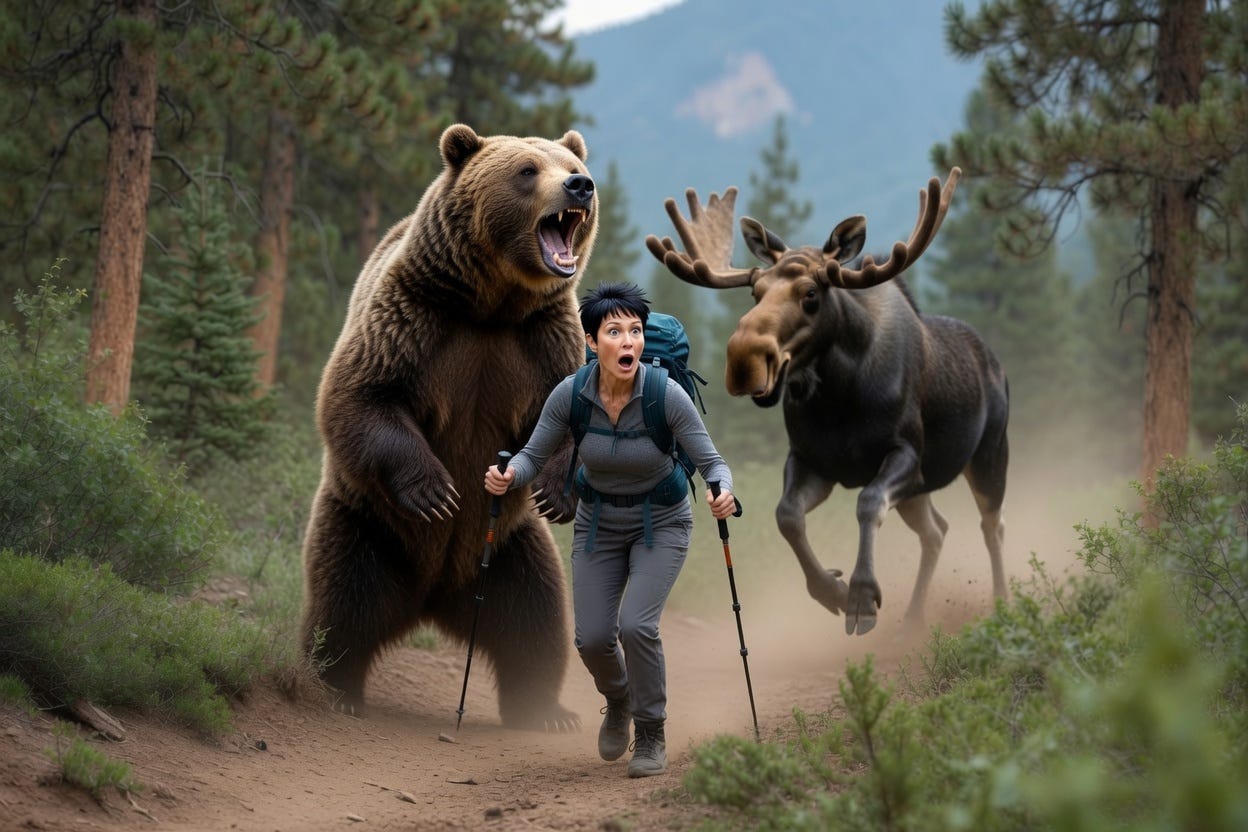
Upon my return home, I did a little research; this is what I learned.
Don’t Surprise a Moose.
Moose are like bears in that they can become defensive if surprised, especially when they have young. Make a little noise while outdoors. There are so many fun ways to do this, whether it’s wearing jingling bells, talking or singing, or, like me, playing a podcast on a mobile speaker.
Keep Your Dog on a Leash.
Dog chases moose → moose chases dog → dog runs to you → angry moose follows. Get it?
If a Moose is Present, Don’t Approach it.
If a moose is present, don’t approach it. Stay at least 50 feet away. If your presence causes the moose to stop eating, shift its body, or change its behavior in any way, you are already too close. Make sure there’s a tree or other solid barrier nearby you can get behind if needed.
In Fact, Leave the Area.
If it doesn’t know you’re there, quietly walk away.
If it’s aware of you, talk softly and slowly walk away.
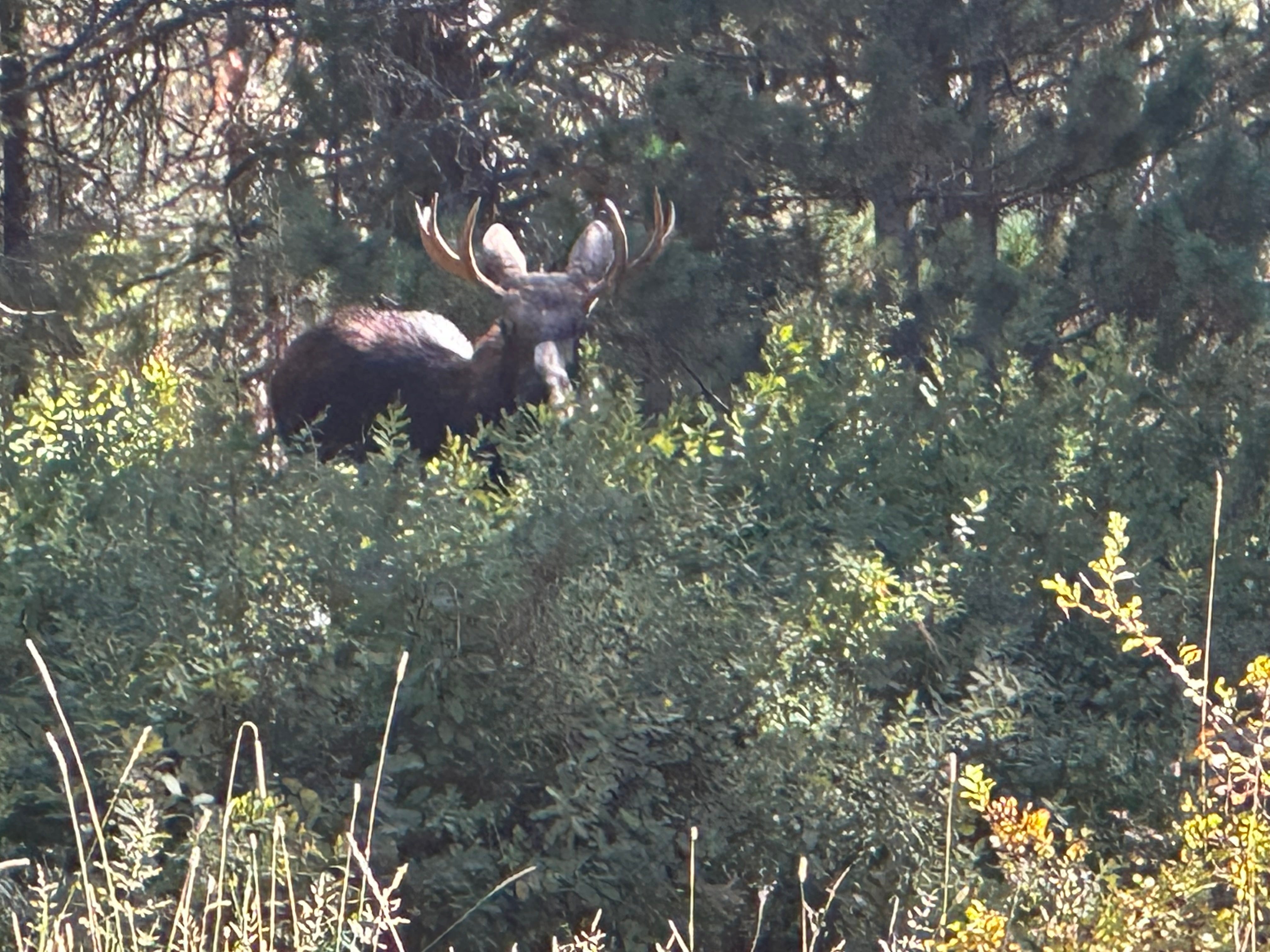
Pay Attention to Its Body Language.
Are its ears laid back?
Hair on its shoulders standing up?
Is it snorting or grunting?
Stomping?
It might be preparing to charge. Get behind that nearby tree!
Don’t Climb Up a Tree – Get Behind It.
That nearby tree is to act as a barrier. Don’t climb up it. Moose can’t climb, but they can wait below it, trapping you.
If it Charges, Run – Preferably Behind a Tree or Other Barrier!
This is different than how to behave with bears. Moose typically will not chase for long. Additionally, running around a barrier is often effective because moose can’t easily change direction.
No Barrier Nearby, Bear Spray is an Option.
If a moose begins to charge and there is no barrier to run behind, bear spray is an option. When it’s between 20 – 30 feet away, pull the bear spray trigger for 3 – 4 seconds. With a bear, shoot it low, below the waist, but with a moose, which is taller, spray above chest level.
If a Moose Attacks, and There’s No Other Option, Play Dead.
Get down on the ground, cover your head, and stay very still. Show that you are not a threat. Be prepared for the moose to kick you with both its front and hind hooves. Prolonged attacks are rare.
Hopefully, none of us ever upsets a moose. They are beautiful creatures to behold. But it’s better to be prepared for how to react than to be unnecessarily anxious when we traverse common ground.
Want to dig deeper into moose behavior and safety? These are the sources I found most useful:
Appalachian Mountain Club. “Do You Know How to Respond to a Moose Encounter?” AMC Outdoors, www.outdoors.org/resources/amc-outdoors/outdoor-resources/responding-to-moose-encounters/.
Clarke, Julia. “After Several Moose Stompings This Year, We Ask the Question – Can You Use Bear Spray on a Moose?” Advnture, 11 July 2024, www.advnture.com/features/bear-spray-on-moose.
Idaho Department of Fish and Game. “Magnificent Moose.” Wildlife Express, vol. 35, no. 1, Sept. 2021, idfg.idaho.gov/sites/default/files/wildlife-express-moose-0821.pdf.
National Park Service. “Moose Safety.” Wrangell-St. Elias National Park & Preserve, 9 Feb. 2016, www.nps.gov/wrst/planyourvisit/moose-safety.htm.
Washington Department of Fish and Wildlife. “The Truth About Bear Spray — It’s Not Just for Bears.” Medium, https://wdfw.medium.com/the-truth-about-bear-spray-its-not-just-for-bears-13191225129f. Accessed 23 July 2026.